- AWS-Native · WCAG 2.1 AA · Section 508 · PDF/UA
PDF Accessibility Remediation for Higher Education & Libraries
PureData Cloud’s AI-powered PDF accessibility tool automatically tags document structure, detects reading order, generates semantic alt text, and produces WCAG 2.1 AA compliant PDFs inside your own AWS environment. Built for colleges, universities, and libraries facing ADA Title II deadlines.
Deployed in your AWS account, not a shared SaaS
Powered by Adobe Acrobat Services API
No per-user licensing fees
One-click deployment via AWS CloudFormation
Deployed in your AWS account, not a shared SaaS
Powered by Adobe Acrobat Services API
No per-user licensing fees
One-click deployment via AWS CloudFormation
- The Compliance Problem
Your Document Library is a Legal Liability You Haven't Fixed Yet
Most organizations are sitting on thousands of inaccessible PDFs: course catalogues, research reports, financial disclosures, grant applications. Most of them don’t meet WCAG 2.1 AA, ADA, or Section 508 standards. The exposure is real.
Digital accessibility lawsuits filed in the U.S. in 2025, across federal and state courts.
Source: UsableNet 2025 Year-End Report
Of the top one million home pages have detectable WCAG 2 failures.
Source: WebAIM Million 2026
Of U.S. undergraduates report having a disability, students who depend on accessible course materials.
Source: NCES, 2019–20
People worldwide live with a disability, about 1 in 6 of the global population.
Source: World Health Organization
- ADA Title II Deadlines
ADA Title II PDF Deadlines for Colleges & Libraries
The DOJ’s 2024 ADA Title II rule requires public colleges, universities, and library systems to make web content, including PDFs, meet WCAG 2.1 Level AA. In April 2026 the DOJ pushed the compliance dates back one year. The technical standard did not change.
Public entities serving 50,000+ people
State universities and public colleges that are part of a state government, large city and county library systems, and large public school districts.
Public entities under 50,000 and special districts
Smaller municipalities and their libraries, library and college districts organized as special district governments, and smaller school districts.
What the rule covers
- PDFs and other documents on your website, online catalog, digital collections, and learning management system
- Content you provide directly or through vendors and contractors
- Every new document published after your compliance date
Narrow exceptions
- Archived content kept only for reference and not updated
- Documents posted before the compliance date, unless people use them to apply for or access your services
- Content posted by third parties, individualized password-protected files, and older social media posts
What this means in practice: course catalogs, syllabi, applications, forms, policies, and library finding aids that students and patrons use today must meet WCAG 2.1 AA, even if they were posted years ago. Private colleges and libraries are covered by ADA Title III and, when they receive federal funds, Section 504, where WCAG 2.1 AA is the benchmark commonly used in settlements and Office for Civil Rights resolution agreements.
Sources: ADA.gov fact sheet on the Title II web rule; DOJ interim final rule, April 20, 2026. This summary is for planning purposes and is not legal advice.
- PDF APIs Savings
Now Save Your Cost On Adobe API

File stored in your S3 bucket. No AWS compute runs. No Adobe API call is made. Cost: a fraction of a cent in storage per month.
- S3 storage only

A shareable URL is generated immediately. Publish it to your website, catalogue, or portal straight away no waiting for remediation to finish.
- Publish before processing

Genuine first access fires the full pipeline: AWS Textract for structure extraction, the Adobe Acrobat Services API for WCAG tagging, AI alt text, compliance check. Viewer sees the original plus a professional notice while it runs.
- Adobe API charged here — not on upload

The same permanent link now serves a fully compliant PDF to every future visitor. No staff action, no CMS update, no redirect. Ever.
- Same link, forever

Upload your entire collection in one batch. Every document gets a live, published link before a single API call is made.

The most expensive part of remediation — Adobe Acrobat Services is deferred entirely until genuine access. No wasted calls on files nobody opens.

The permanent URL always serves the best available version original while processing, compliant PDF once done. No broken links, ever.

Same pipeline, same compliance report as bulk processing. No quality trade-off every accessed document is fully certified.
- Pricing & Cost
What Does PDF Remediation Cost With PureData Cloud?
No per-user licenses, and no paying to remediate files nobody reads. Your costs come from three places.
AWS infrastructure
Pay-as-you-go AWS services (S3, Lambda, Textract) billed to your own AWS account. No shared tenancy and no markup on infrastructure.
Adobe Acrobat Services API
Billed per Adobe document transaction under your own Adobe agreement. Auto-Tag uses 10 transactions per page, and Adobe includes 500 free transactions each month. With point-in-time remediation, the API runs only when a document is first opened.
PureData deployment and support
One-click CloudFormation deployment, onboarding, and ongoing support, quoted to your document volume. No per-user licensing fees.
Example: a 100,000-PDF archive where 20% of files are ever opened
- Remediate everything up front: all 100,000 documents go through the Adobe API
- Point-in-time remediation: only the 20,000 opened documents do, 80% fewer Adobe API transactions and the fees that come with them
Illustrative only. Your open rate and Adobe rates will vary (see Adobe’s transaction metering). For reference, ITHAKA (JSTOR) reports about $0.026 per page for its own on-demand remediation pipeline on AWS (AWS Public Sector Blog).
- Platform Features
Everything You Need to Achieve and Maintain PDF Compliance
From AI-powered automated remediation to manual post-processing tools and a full compliance dashboard PureData gives your team complete control over accessibility at scale.

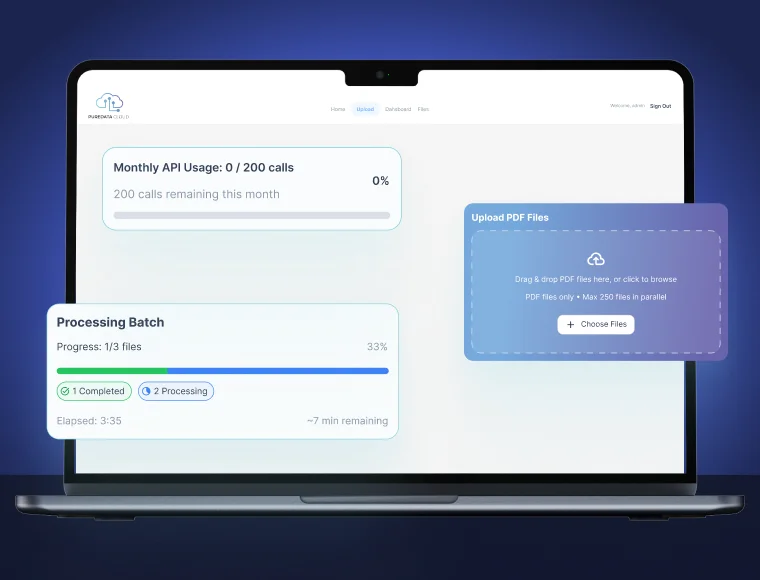
Upload one PDF or a full S3 bucket. The engine processes every document in parallel using AWS Lambda no queue waiting, no per-file bottlenecks.

AI detects and applies WCAG-required PDF tags: Document, Sect, P, H1–H6, Table, Figure, List with correct nesting and tag hierarchy for screen readers.

Computer vision models describe charts, diagrams, and images in context-aware language not generic placeholders. Reviewable before final output.

All processing runs within your VPC. Documents never leave your AWS account. Data sovereignty maintained for FERPA, HIPAA, and government compliance.
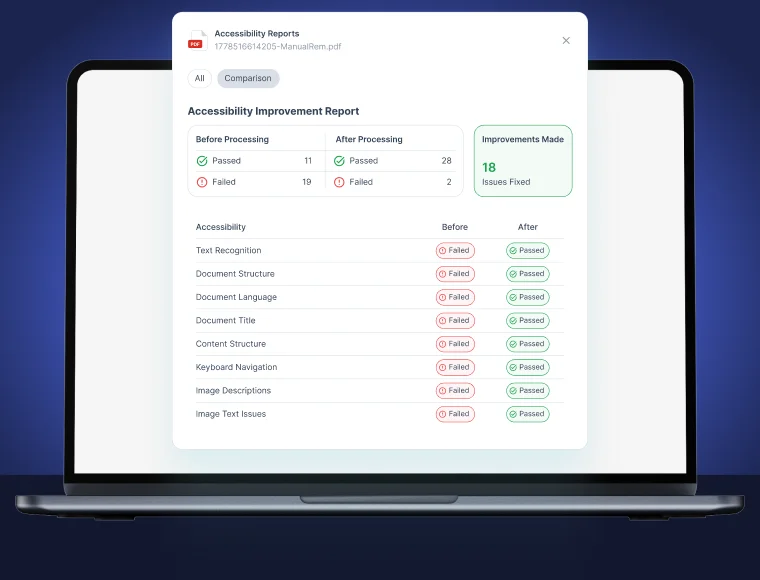
Multi-column layouts, sidebars, callout boxes, and footnotes are correctly sequenced so screen readers navigate content in the intended reading flow.

Complex merged-cell tables are tagged with TH scope attributes, summary attributes, and header-ID associations per WCAG 2.1 Success Criterion 1.3.1.

Document-level and passage-level language tags applied automatically. Title, author, and subject metadata injected to meet PDF/UA clause 7.1 requirements.
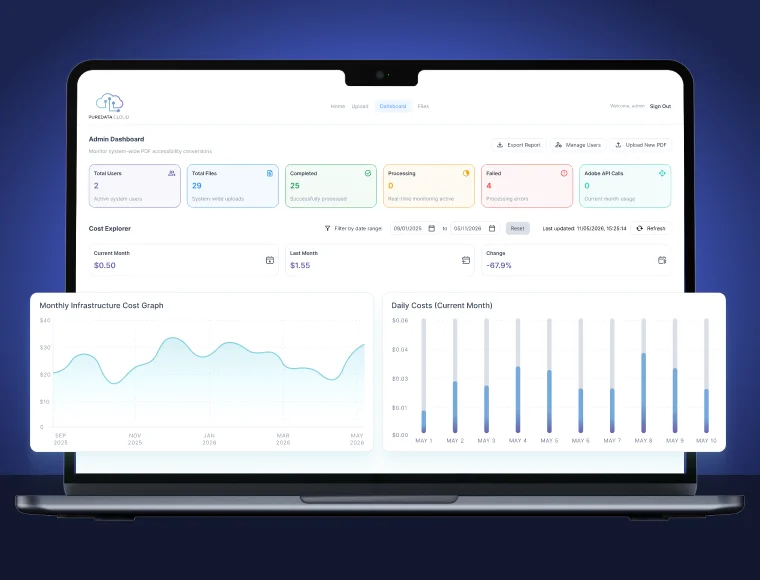
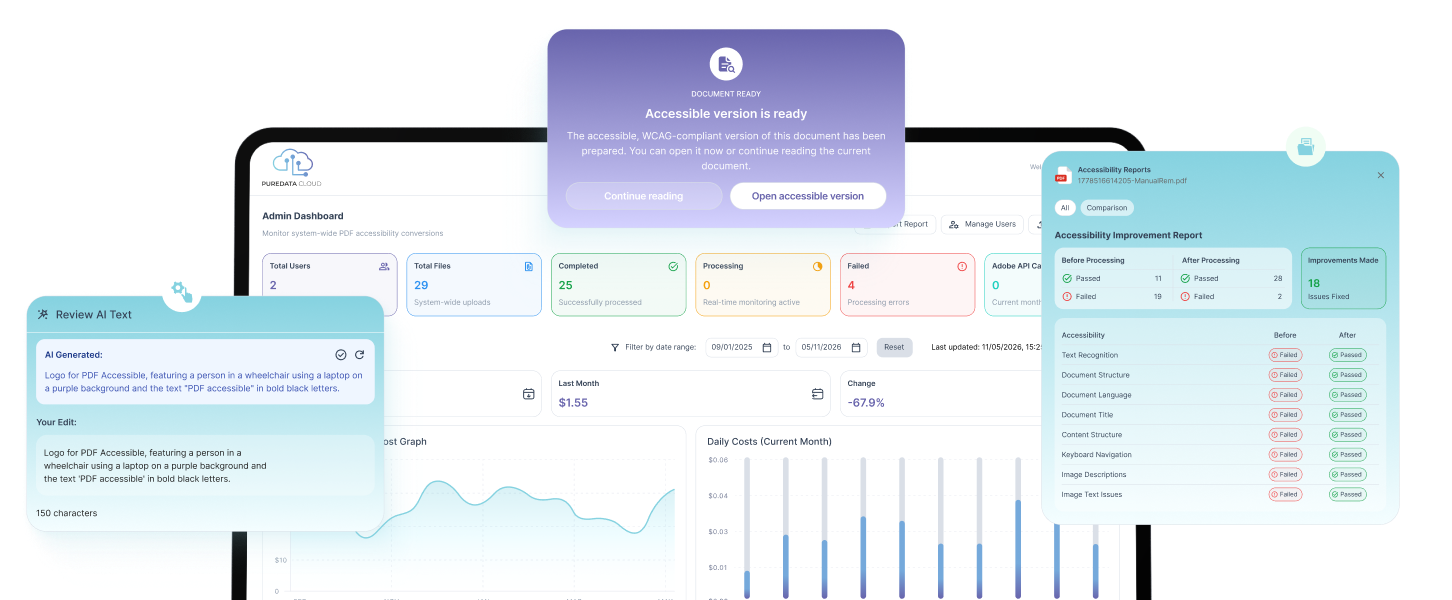
Track remediation status, WCAG pass/fail rates, and pending review items across your entire document library from a single dashboard.

Per-document AWS cost breakdown and Adobe API usage metrics so your finance team has the data to forecast accessibility operations budget.

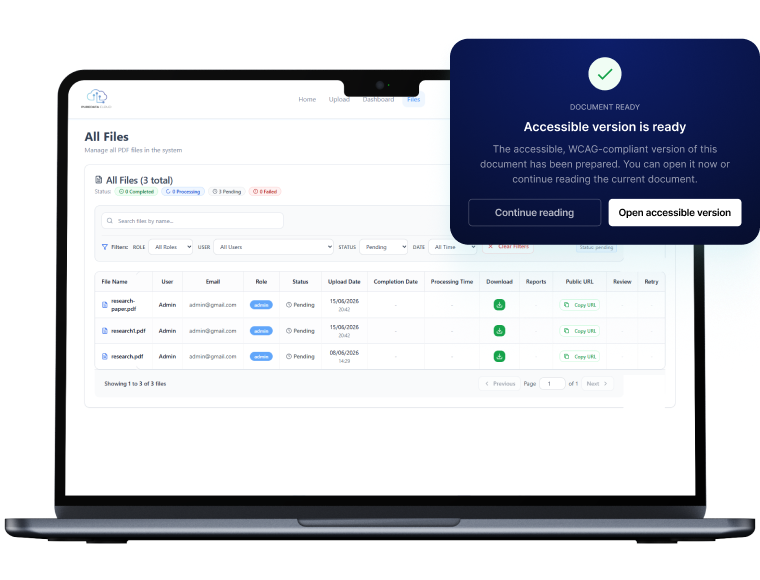
Search by filename, filter by uploader email, role, date range, and compliance status. Combine filters for instant scoped reporting.
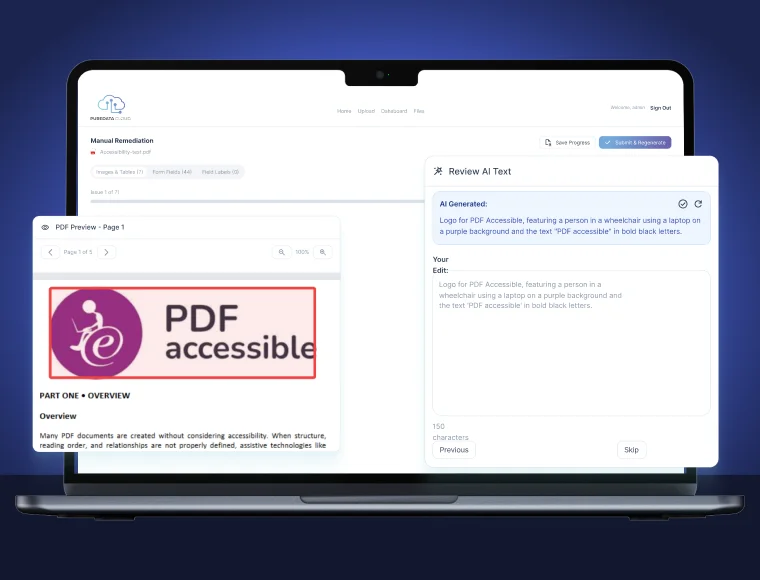
AI-generated alt text is surfaced for human review on complex images, charts, and decorative elements with one-click accept or inline editing before publishing.

Add, label, and validate interactive PDF form fields post-processing. Ensures ARIA-equivalent labeling for screen reader navigation of fillable forms.

Every manual edit is logged with timestamp, user, and change type producing a defensible compliance record for audits, procurement, and legal proceedings.

- Implementation Process
From Upload to Compliant PDF in Four Steps
Designed for accessibility teams, IT departments, and document operations managers. No developer skills required for day-to-day remediation workflows.
- AWS CloudFormation
- S3 · REST API
- AWS AI
- WCAG 2.1 AA output
- How We Compare
PureData Cloud vs. Other PDF Remediation Options
Most colleges and libraries weigh three paths: outsourcing to a manual remediation vendor, licensing a SaaS tool, or running remediation in their own cloud. Here is how they compare.
| Criteria | PureData Cloud | Manual remediation services | Typical SaaS remediation tools |
|---|---|---|---|
| Where documents are processed | Your own AWS account and VPC | Vendor staff and systems | Vendor's shared cloud |
| Pricing model | AWS usage plus Adobe API per document, no per-user fees | Per page, quoted per project | Per-user seats or annual page tiers |
| Pay for files nobody opens? | No, point-in-time remediation runs on first access | Yes, every file is quoted | Usually yes, files are processed on upload |
| Turnaround | 5–15 minutes per document, processed in parallel | Days to weeks per batch | Minutes to hours |
| Scale | Entire archives in one batch | Limited by staff capacity | Limited by plan tier |
| Scanned PDFs | OCR with AWS Textract | Yes, by hand | Varies by tool |
| Alt text | AI-generated in context, reviewable | Written by people | Varies by tool |
| Links after remediation | Same permanent URL, no re-uploads | Fixed files must be re-uploaded | Often new files or URLs |
| Compliance reporting | Dashboard and timestamped audit trail | Per-project reports | Varies by tool |
| Student and patient data (FERPA, HIPAA) | Never leaves your AWS account | Shared with the vendor | Shared with the vendor |
Complex STEM, math-heavy, and form-heavy documents still benefit from human review. PureData flags them in the dashboard so your team can check them before publishing.
- Compliance Standards
Every Standard Your Organization is Legally Required to Meet
Web Content Accessibility Guidelines, the technical standard named in the DOJ’s ADA Title II rule and referenced by Section 508 and EN 301 549.
Mandatory for federal agencies and contractors. Revised 508 standards align to WCAG 2.0 AA with additional electronic document requirements.
Private colleges, libraries, and organizations face Title III lawsuits over inaccessible websites and documents, with more than 5,000 filed in 2025. Public institutions fall under Title II (see the deadlines above).
The international standard for universally accessible PDF files. Widely referenced in government and higher education procurement requirements.
- Technical Architecture
Enterprise-Grade Infrastructure, Deployed in Your AWS Account
Single CloudFormation template provisions all resources — VPC, Lambda functions, S3 buckets, IAM roles — in under 15 minutes with zero manual configuration.
- AWS Cloud Formation
- VPC
- IAM
Serverless Lambda functions process documents in parallel. Auto-scales to handle batches of 10,000+ files without pre-provisioned capacity.
- AWS Lambda
- S3
- SQS
AWS Textract extracts document structure and text. Custom computer vision models generate context-aware alt text. Adobe Acrobat Services API applies WCAG-compliant PDF tags.
- AWS Textract
- Bedrock
All data encrypted at rest (AES-256) and in transit (TLS 1.3). S3 bucket policies prevent cross-account access. CloudTrail logging on every API call.
- AES-256
- TLS 1.3
- CloudTrail
CloudWatch dashboards track processing latency, error rates, and API consumption. SNS alerts notify admins of processing failures or compliance threshold breaches.
- CloudWatch
- SNS
- X-Ray
REST API and webhook support for integration with SharePoint, Drupal, WordPress, and document management systems. S3 event triggers for automated pipeline ingestion.
- REST API
- Webhooks
- S3 Events
- Who We Serve
Built for Every Organization With a Document Accessibility Obligation
Serve patrons with visual impairments, dyslexia, and cognitive disabilities through fully accessible digital collections. Public and state university libraries must meet WCAG 2.1 AA under the ADA Title II rule, alongside ALA accessibility commitments.
Federally funded libraries also carry Section 504 obligations
Public school districts fall under the same ADA Title II rule, with the same 2027 and 2028 deadlines. Make board packets, family notices, and curriculum documents accessible to students and parents who use screen readers.
From the PureData team behind 500+ school and district partnerships

Mandatory Section 508 compliance for all electronic documents published or distributed by federal agencies. Avoid DOJ enforcement investigations and Civil Rights Division findings.
Section 508 non-compliance exposes agencies to formal complaints

Accessible patient-facing PDFs satisfy ADA Section 504 obligations for healthcare recipients. Protect HIPAA-compliant workflows with AWS-native processing that never routes PHI to third-party servers.
HIPAA-safe: all processing stays within your AWS VPC
- K-12 School Districts
PDF Accessibility for K-12 School Districts
Public school districts fall under the same ADA Title II rule and the same WCAG 2.1 AA standard as public colleges and libraries.
Board and policy documents
Board meeting packets, minutes, budgets, and district policies that families and community members read online.
Family and enrollment notices
Enrollment packets, student handbooks, newsletters, and forms that parents with disabilities need to read and complete.
Curriculum and classroom files
Curriculum guides, assignments, and teacher-created PDFs shared through your website or learning platform.
PureData has supported 500+ schools and districts with PowerSchool, Google Workspace, and cloud services for over 15 years, so we know how district documents are created, published, and maintained. Learn about PureData's K-12 services.
- Frequently Asked Questions
Technical and compliance questions, answered
When do public colleges and libraries have to comply with ADA Title II?
Under the DOJ’s April 2026 interim final rule, public entities serving 50,000 or more people must meet WCAG 2.1 Level AA by April 26, 2027. Smaller public entities and special district governments have until April 26, 2028. State universities and most public colleges generally fall under the 2027 date because they are part of a state government.
Do PDFs posted before the deadline need to be remediated?
Usually, yes. The rule exempts older documents only if nobody uses them to apply for, access, or participate in your services, and it exempts archived content kept only for reference. Course catalogs, syllabi, forms, applications, policies, and finding aids in active use must be accessible regardless of when they were posted.
What WCAG 2.1 success criteria does the auto-remediation engine address?
The engine addresses all document-applicable Level AA success criteria including: 1.1.1 (non-text content / alt text), 1.3.1 (info and relationships / structural tagging), 1.3.2 (meaningful sequence / reading order), 1.3.3 (sensory characteristics), 2.4.2 (page titled), 3.1.1 (language of page), and 4.1.2 (name, role, value for form elements). Complex criteria requiring human judgment such as 2.4.6 headings and labels adequacy are flagged for manual review.
Does the tool handle scanned (image-based) PDFs, not just born-digital documents?
Yes. AWS Textract performs OCR on scanned documents before remediation, extracting the text layer required for structural tagging. For heavily degraded scans, OCR confidence scores are surfaced in the review queue so operators can manually verify extraction quality before the document is published as accessible.
How is our data protected during processing?
All processing occurs exclusively within your own AWS account and VPC. Documents are stored in S3 buckets you own and control, with server-side encryption (AES-256) enforced by bucket policy. Lambda functions process documents ephemerally. No document content is retained in function memory after processing completes. CloudTrail records every API call for audit purposes. For regulated industries, we support HIPAA Business Associate Agreements through AWS native controls.
What does the Adobe Acrobat Services API do, and is there an additional cost?
Adobe Acrobat Services API is the industry-standard PDF manipulation engine used to apply WCAG-compliant structural tags, reading order, and metadata to processed documents. Adobe API usage is billed per document transaction under your own Adobe agreement. Auto-Tag uses 10 transactions per page, and Adobe includes 500 free transactions each month. Your admin dashboard shows real-time API call consumption so you can forecast monthly Adobe costs alongside your AWS infrastructure spend.
Can PureData integrate with our existing document management system or CMS?
Yes. The platform exposes a REST API that accepts document upload requests and returns compliant PDF download URLs. S3 event triggers allow documents deposited into a designated S3 prefix to be automatically queued for processing, enabling no-code integration with SharePoint, Drupal, WordPress, Hyland OnBase, and other document management systems that support S3 or webhook callbacks.
Is this tool sufficient to protect us from ADA litigation?
PureData Cloud produces WCAG 2.1 AA compliant output and generates a documented, timestamped remediation audit trail, both of which are foundational to a defensible accessibility program. We always recommend pairing automated remediation with a periodic human audit and legal review. Automated tools address the majority of technical accessibility barriers, but demonstrating good-faith, ongoing compliance efforts is also a significant factor in ADA litigation outcomes.
How much does PDF remediation cost with PureData Cloud?
There are no per-user licenses. You pay AWS infrastructure costs in your own account, Adobe Acrobat Services API fees (billed per document transaction under your Adobe agreement and charged only when a document is first opened), and PureData deployment and support quoted to your document volume. Contact us for an estimate based on your library size.
Ready to Make Your PDFs Accessible?
Whether you’re a university, library, government agency, or enterprise, our PDF Accessibility Tool helps you create accessible, compliant, and user-friendly documents with confidence. Fill out the form, and our accessibility experts will show you how we can simplify PDF remediation and support your compliance goals.